Wenlock Books has been nominated for an award.
Nothing to do with me, or this blog, however. The Wenlock Books in question is a small bookshop in Much Wenlock which has been nominated for the National Book Trade Award for independent bookshop of the year (thanks to Galleycat for the tip-off).
While I was in Shropshire last May, writing a fair chunk of Lord Alexander's Cipher; or, the Bridekirk Behemoth (thanks for the suggestions for alternative titles - I still haven't hit on the perfect one quite yet), I visited Wenlock Books. They manage to cram a huge number of books into a very small space, and they tended to be books that I wanted to read, rather than the latest ghost-written celebrity autobiography.
I'd like to wish them the best of luck with the award, which will be announced on 9 May.

Stephen Bowden, now an e-published writer of Regency romps, ventures back into the Blogosphere.
Saturday, 8 April 2006


Monday, 3 April 2006
Miss Snark gives her readers less than 24 hours to enter a writing competition, and gets over a hundred entries. That says something about the devotion of the snarklings. The offerings are being posted now, but it will probably take a week for them all to appear. They are going up in the order that they were submitted, and it looks as if the quality is improving as people took longer to draft and redraft. Yet even in the 18 that I have seen so far there are a few really cracking efforts. It will be interesting to see how mine fares at the hands of the snarkling commentariat.
Of course I shouldn't have entered; I should have used the time to push on with the rewrites. I also have the tricky business of coming up with a better title. Anne-Marie is happy with the Bridekirk Behemoth, but feels that Lord Alexander's Cipher isn't quite right, as he neither creates nor breaks the cipher in question. The trouble is, having lived with LAC;o,tBB for so long it is hard to get my head round any alternatives. I shall take advice at the RNA Oxford Chapter lunch tomorrow.
I am, as ever, open to suggestions from my dear readers too.
Of course I shouldn't have entered; I should have used the time to push on with the rewrites. I also have the tricky business of coming up with a better title. Anne-Marie is happy with the Bridekirk Behemoth, but feels that Lord Alexander's Cipher isn't quite right, as he neither creates nor breaks the cipher in question. The trouble is, having lived with LAC;o,tBB for so long it is hard to get my head round any alternatives. I shall take advice at the RNA Oxford Chapter lunch tomorrow.
I am, as ever, open to suggestions from my dear readers too.
Sunday, 2 April 2006
The indefatigable Miss Snark is holding a competition. If you are reading this on Sunday you may still have time to enter. Apparently there is to be a prize. I've submitted my entry. When they are all up, I'll ask if anybody can work out which one it is.
In 1809 the journey from Painswick to reading would have taken a day. I have not managed to work out the route from Paterson's Roads, but I doubt that it would have been straightforward.
For me it was simply a matter of following the instructions from my GPS unit, and putting up with a bit of a cross-wind and the odd shower. It took me less than two hours.
My destination was Reading Town Hall, where Julie Cohen was launching her first two books for Mills and Boon.
 In Featured Attraction, the hero and heroine find themselves trapped overnight inside a cinema, with a year's supply of popcorn, a year's supply of chocolate-covered raisins, and a year's supply of condoms. It was appropriate that beside the champagne, we toasted Julie's success with at least two of those items.
Being a Bad Girl features a hero who rides a motorbike. She had never ridden on one before she wrote it, although she managed to charm a young man at her local Harley Davidson dealer into telling her all about it. Julie's first ride came when I gave her a lift on the back of my bike during last year's RNA conference. For that she very kindly gave me an acknowledgement in Being a Bad Girl, although she had to admit that the book was already with Mills and Boon, so I cannot really claim to have contributed to the creative process.
Thanks to Rosie for the photo of Julie being deservedly happy.
For me it was simply a matter of following the instructions from my GPS unit, and putting up with a bit of a cross-wind and the odd shower. It took me less than two hours.
My destination was Reading Town Hall, where Julie Cohen was launching her first two books for Mills and Boon.
 In Featured Attraction, the hero and heroine find themselves trapped overnight inside a cinema, with a year's supply of popcorn, a year's supply of chocolate-covered raisins, and a year's supply of condoms. It was appropriate that beside the champagne, we toasted Julie's success with at least two of those items.
Being a Bad Girl features a hero who rides a motorbike. She had never ridden on one before she wrote it, although she managed to charm a young man at her local Harley Davidson dealer into telling her all about it. Julie's first ride came when I gave her a lift on the back of my bike during last year's RNA conference. For that she very kindly gave me an acknowledgement in Being a Bad Girl, although she had to admit that the book was already with Mills and Boon, so I cannot really claim to have contributed to the creative process.
Thanks to Rosie for the photo of Julie being deservedly happy.
Saturday, 1 April 2006
I spent quite a bit of yesterday attending a creative writing workshop at the very lovely Painswick Hotel given by the equally lovely Katie Fforde . The event was being filmed for a three part TV series on romantic fiction presented by Daisy Goodwin, which has been commissioned by the BBC and will be broadcast, if everything goes according to plan, in October.
The three programmes will apparently cover "heroes", "heroines" and "happy ever after" or something like that. Katie structured the day along similar lines, so we started with a discussion of the great romantic heroes - not just Heathcliff, Darcy and Rochester, but also more modern examples like Jilly Cooper's Rupert Campbell-Black. Katie argued that romantic fiction allows the reader to have a safe "virtual affair" with the hero, so we had to make the hero someone that readers would fall for in a big way.
Then we had to do some work. We had ten minutes to write a passage that describes a fictional hero - giving some idea of his appearance, what he does, what sort of car he drives, what he's like - but does so allusively, rather than through straightforward physical description. Show, not tell.
After we had read out our passages (and taken a coffee break, and some shorter breaks to change tapes in the camera, reshot the odd fluffed comment from Katie, and worked through all the other joys of being filmed) we moved on to heroines. We nominated various favourites, and discussed the importance of their being realistic. Readers want to identify with the heroine, so she has to be plausible - achievably beautiful rather than impossibly gorgeous, not too stupid, and so on.
More writing for us. This time we had to describe our heroines, but we had to do it from within their own point of view, with no recourse to looking in mirrors or other popular clichés. Since this is something that I have been wrestling with in Lord Alexander's Cipher; or, the Bridekirk Behemoth, I was glad of the chance to have a go at it in a different context.
Then we discussed the whole question of what constitutes romantic fiction, and romances. Not surprisingly we dsidn't reach a definitive view, but the centrality of a relationship between two people that includes a distinctly sexual element (even if not actually consummated), and the importance of an emotional appeal to the reader were both part of the answer.
Another exercise now; a description of the second time that our hero and heroine from the earlier exercises meet each other. The first meeting is usually a chance encounter. The second shows how the relationship is developing. We had ten minutes to get some of that down on our writing pads.
And at that point, with more tape changing and reshooting being done, I had to leave, to get down to Reading for a book launch, about which more tomorrow.
The three programmes will apparently cover "heroes", "heroines" and "happy ever after" or something like that. Katie structured the day along similar lines, so we started with a discussion of the great romantic heroes - not just Heathcliff, Darcy and Rochester, but also more modern examples like Jilly Cooper's Rupert Campbell-Black. Katie argued that romantic fiction allows the reader to have a safe "virtual affair" with the hero, so we had to make the hero someone that readers would fall for in a big way.
Then we had to do some work. We had ten minutes to write a passage that describes a fictional hero - giving some idea of his appearance, what he does, what sort of car he drives, what he's like - but does so allusively, rather than through straightforward physical description. Show, not tell.
After we had read out our passages (and taken a coffee break, and some shorter breaks to change tapes in the camera, reshot the odd fluffed comment from Katie, and worked through all the other joys of being filmed) we moved on to heroines. We nominated various favourites, and discussed the importance of their being realistic. Readers want to identify with the heroine, so she has to be plausible - achievably beautiful rather than impossibly gorgeous, not too stupid, and so on.
More writing for us. This time we had to describe our heroines, but we had to do it from within their own point of view, with no recourse to looking in mirrors or other popular clichés. Since this is something that I have been wrestling with in Lord Alexander's Cipher; or, the Bridekirk Behemoth, I was glad of the chance to have a go at it in a different context.
Then we discussed the whole question of what constitutes romantic fiction, and romances. Not surprisingly we dsidn't reach a definitive view, but the centrality of a relationship between two people that includes a distinctly sexual element (even if not actually consummated), and the importance of an emotional appeal to the reader were both part of the answer.
Another exercise now; a description of the second time that our hero and heroine from the earlier exercises meet each other. The first meeting is usually a chance encounter. The second shows how the relationship is developing. We had ten minutes to get some of that down on our writing pads.
And at that point, with more tape changing and reshooting being done, I had to leave, to get down to Reading for a book launch, about which more tomorrow.
Sunday, 26 March 2006
 So, if Lord Alexander Harrow looks like Ingres' sketch of Lord Grantham, what does Miss Charlotte Hopesay look like? I have been particularly concerned about this since my agent (hereafter referred to as Anne-Marie, since repeatedly saying "my agent" sounds a bit pretentious) pointed out that I give no physical description of her at all, beyond what she wears.
Well, she's not one of Heyer's junoesque heroines, like Sophia Stanton-Lacy (let salone Nell Stornaway), but neither is she particularly petite. She is not an incomparable beauty like Miss Isabella Milbourne, but she is pretty - even striking - if she wants to be. Her hair is neither flaxen curls nor raven tresses, but a reddish brown, and her eyes are hazel. In other words she looks something like this. Heather Findlay from the progressive rock group Mostly Autumn, who, as it happens, are playing in Cirencester in a couple of week's time. If the concert hasn't sold out yet, I'll be there.
 Since, during the course of Lord Alexander's Cipher; or, the Bridekirk Behemoth, Miss Hopesay is drugged, jilted, goes into the wilds of Gloucestershire where she crawls around in attics, gets knocked on the head, tied up and then caught up in an explosion, she doesn't always look as calm as in that first photograph. But then again, neither does Miss Findlay.
Saturday, 25 March 2006
Today was supposed to be a good day for doing my rewrites, but that didn't seem to happen. I started the day haring around Cheltenham to get a vital part to fix my motorbike (large silver BMW two-cylinder thing - think of it as a pair of matched greys) not to mention securing a copy of the latest Harry Potter DVD in exchange for a chunk of the Wenlock heir's accumulated allowance.
 But the main distraction was sorting out something to wear to a book launch next Friday. The invitation says "sparkly", but my wardrobe doesn't do sparkly, not even a little bit. Clearly it was time to break out the inner Martha Stewart, and create a sparkly T-shirt that was, at least vaguely, me.
I started with Ingres' sketch of Lord Grantham, which is as good an illustration of Lord Alexander Harrow as I can find. With a little messing about on the computer and a great deal more playing around with tracing paper, drafting pens, craft knives and acetate sheets I turned the head and shoulders into a simpler and more striking illustration, in stencil form.
The other design element that I needed was a suitable font for a caption. I went with the Jane Austen font that the nice people at Austenblog alerted me to a while back.
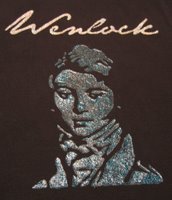 Putting it all together with some glittery fabric paint and a heavy-duty long-sleeved black T-shirt, I came up with this, which, although I say it myself, isn't too bad a result.
As Mrs Wenlock pointed out, if I can't make the novel-writing pay, I could always set up a stall at Camden Market selling glittery T-shirts to Goths with Regency tastes.
But the main distraction was sorting out something to wear to a book launch next Friday. The invitation says "sparkly", but my wardrobe doesn't do sparkly, not even a little bit. Clearly it was time to break out the inner Martha Stewart, and create a sparkly T-shirt that was, at least vaguely, me.I started with Ingres' sketch of Lord Grantham, which is as good an illustration of Lord Alexander Harrow as I can find. With a little messing about on the computer and a great deal more playing around with tracing paper, drafting pens, craft knives and acetate sheets I turned the head and shoulders into a simpler and more striking illustration, in stencil form.
The other design element that I needed was a suitable font for a caption. I went with the Jane Austen font that the nice people at Austenblog alerted me to a while back.
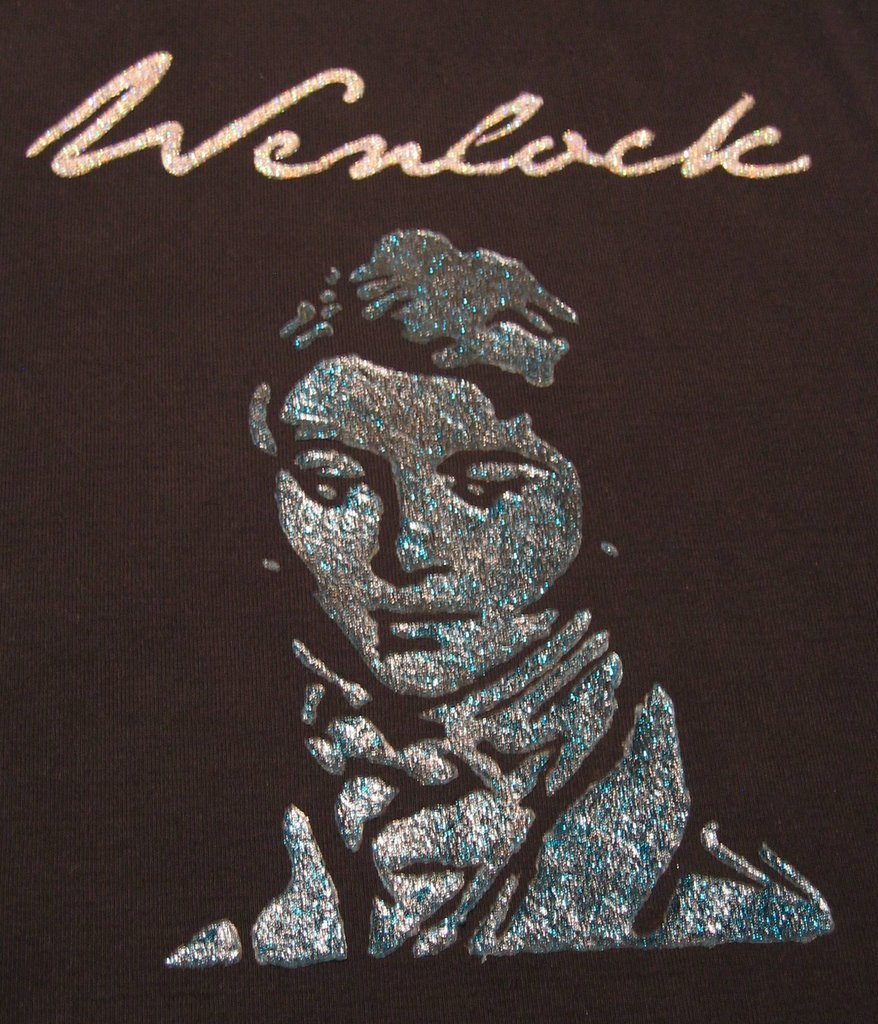 Putting it all together with some glittery fabric paint and a heavy-duty long-sleeved black T-shirt, I came up with this, which, although I say it myself, isn't too bad a result.
As Mrs Wenlock pointed out, if I can't make the novel-writing pay, I could always set up a stall at Camden Market selling glittery T-shirts to Goths with Regency tastes.
Thursday, 23 March 2006
OK, so it may not quite have the kudos of the list written in a book of gold by the angel encountered by Abou Ben Adhem (may his tribe increase), but Ampersand have updated their client list, and Lo! My name leads all the rest.
Sunday, 19 March 2006
Heyeroines in need of a slap
21. Cressida Stavely (False Colours)
 The discovery that a man has spent an entire evening at your home lying to you about almost every important aspect of himself might provoke a range of reactions in any young lady of gentle birth and finely-honed sensibility. Blithely forming a cladestine understanding with him would not usually fall within this range. That, however, is how Miss Stavely responds to the dishonourable behaviour of the Honourable Christopher Fancot.
Of course any woman might make a mistake, and had Miss Stavely resiled from her initial course of action once she had discovered a little more about the Fancot menage all might have been forgotten, but this is not to be.
Quizzed in the course of that first fateful evening by the Dowager Lady Stavely, not even Kit Fancot, in training to be sent abroad to lie for his country, could conceal the fact that he had an Uncle called Brumby. What Cressy soon learns, however, is that Brumby is not his only uncle. Indeed Brumby is not his most bizarrely-named uncle. That particular laurel falls to his uncle Cosmo Cliffe.
This should have been more than enough to send any sensible girl running from the Fancot family with all the speed she could muster, but Miss Stavely apparently thinks herself to be made of sterner stuff. This is, perhaps due to her belief that her first name is, if not as heroic as that of Miss Wantage in Friday's Child, at least somewhat epic and heroic.
There is a limit even to epic heroism, and the character of Lady Denville should have alerted her that she was over the limit. Much can be made of the relative contributions to a person's character from nature and nurture, but Kit Fancot must have been indebted to his mother for the overwhelming majority of each. Lady Denville's idea of frugality is, after all, to limit her supply of household necessities to forty eight pounds of wax lights and two casks of genuine spermaceti oil (allegedly from Barret, but originally from a genuine sperm whale), two Westphalian Hams, several pounds of tea, superfine vanilla, treble-refined sugar and a large quantity of wafers from Gunter's.
But the real danger does not come from Lady Denville, but from her constant companion, Sir Bonamy Ripple, to whom the above might serve as a late evening snack. Bonamy Ripple sounds like a large and unhealthy desert dish, but on closer examination he turns out to be a very large meal, with several removes involving quail, ducklings, and a green goose. He is also distinctly catching. Within a few pages of Sir Bonamy's appearance in the book (page 79 in the Arrow edition), Miss Stavely finds herself "in a little ripple of amusement" (page 123). By page 277 she has aquired "gravity" and is talking of widgeons. Whatever it is that Sir Bonamy spreads about him, while it may not be 'flu, it is quite definitely avian.
And yet still Miss Stavely appears to maintain the illusion that she can cope with all this, and that thanks to whatever she has taken from her great namesake, she can win through despite the hugely unfavourable odds.
I fear that she is mistaken. The original of her name was a tragic heroine who betrayed her lover with a greek warrior. The victory against overwhelming odds was spelled "Crécy".
Technorati Tags: heyeroines
21. Cressida Stavely (False Colours)
The discovery that a man has spent an entire evening at your home lying to you about almost every important aspect of himself might provoke a range of reactions in any young lady of gentle birth and finely-honed sensibility. Blithely forming a cladestine understanding with him would not usually fall within this range. That, however, is how Miss Stavely responds to the dishonourable behaviour of the Honourable Christopher Fancot.Of course any woman might make a mistake, and had Miss Stavely resiled from her initial course of action once she had discovered a little more about the Fancot menage all might have been forgotten, but this is not to be.
Quizzed in the course of that first fateful evening by the Dowager Lady Stavely, not even Kit Fancot, in training to be sent abroad to lie for his country, could conceal the fact that he had an Uncle called Brumby. What Cressy soon learns, however, is that Brumby is not his only uncle. Indeed Brumby is not his most bizarrely-named uncle. That particular laurel falls to his uncle Cosmo Cliffe.
This should have been more than enough to send any sensible girl running from the Fancot family with all the speed she could muster, but Miss Stavely apparently thinks herself to be made of sterner stuff. This is, perhaps due to her belief that her first name is, if not as heroic as that of Miss Wantage in Friday's Child, at least somewhat epic and heroic.
There is a limit even to epic heroism, and the character of Lady Denville should have alerted her that she was over the limit. Much can be made of the relative contributions to a person's character from nature and nurture, but Kit Fancot must have been indebted to his mother for the overwhelming majority of each. Lady Denville's idea of frugality is, after all, to limit her supply of household necessities to forty eight pounds of wax lights and two casks of genuine spermaceti oil (allegedly from Barret, but originally from a genuine sperm whale), two Westphalian Hams, several pounds of tea, superfine vanilla, treble-refined sugar and a large quantity of wafers from Gunter's.
But the real danger does not come from Lady Denville, but from her constant companion, Sir Bonamy Ripple, to whom the above might serve as a late evening snack. Bonamy Ripple sounds like a large and unhealthy desert dish, but on closer examination he turns out to be a very large meal, with several removes involving quail, ducklings, and a green goose. He is also distinctly catching. Within a few pages of Sir Bonamy's appearance in the book (page 79 in the Arrow edition), Miss Stavely finds herself "in a little ripple of amusement" (page 123). By page 277 she has aquired "gravity" and is talking of widgeons. Whatever it is that Sir Bonamy spreads about him, while it may not be 'flu, it is quite definitely avian.
And yet still Miss Stavely appears to maintain the illusion that she can cope with all this, and that thanks to whatever she has taken from her great namesake, she can win through despite the hugely unfavourable odds.
I fear that she is mistaken. The original of her name was a tragic heroine who betrayed her lover with a greek warrior. The victory against overwhelming odds was spelled "Crécy".
Technorati Tags: heyeroines
Heyeroines in need of a slap
20. Nell Cardross (April Lady)
 Once again I suspect that there might be some debate over who the true heyeroine of April Lady might be. At no point is the expression used to describe Lady Cardross or (nor indeed Lady Letitia Merion). This must inevitably leave those who believe Miss Amanda Summercourt to be the heyeroine of Sprig Muslin at a bit of a loss. They might, of course, put forward the argument that a true heyeroine, even if she doesn't end up marrying the heyero, must appear in the first chapter. A careful review of the start of the book does indeed reveal a potential candidate on page 16 of the Arrow edition.
Unfortunately, despite this promising start, old Mother Wenlock makes no further appearance in the story, so I fear that, for all her magnificent and noble characteristics, we cannot count her as the heyeroine. That pretty much leaves us with no viable option other than the Countess of Cardross.
This immediately presents us with a problem. Read as a simple romance, April Lady has little to recommend it. The plot appears to be a simple rehash of The Convenient Marriage, but without a compelling villain, or perhaps Friday's Child without, well, without whatever it is that makes that worth reading. The "Nemesis" stuff, probably.
But it would be an error to treat April Lady as a romance. It is clearly a thriller. The relationship between Giles and Nell is well handled of course, but it is really a sideshow. The heart of the book concerns Madame Lavalle, and her partner, Mr Warren, the perfumier.
Note that we are never actually told why Madame Lavalle is making such spirited attempts to dun one of her more best clients. This is, of course, a great example of Miss Heyer expecting her readers to work it out for themselves. As you would expect from a mistress of whodunnits, the clues are all there, and it is in the first chapter that the key pointer can be found. It is Mr Warren's bill for Olympian Dew.
The Irvine family have something of a reputation for what we would nowadays refer to as addictive personalities. In the case of Lord Pevensey this expresses itself in a tendenct to gamble. In the case of his son, Viscount Dysart, it finds its expression in a compulsion to carve his initials in every tree in St James' Park, and to time himself doing so. In Nell's case it is substance abuse, and, primed by the reference to Nell's substance of choice, we can spot the tell-tale signs of addiction in much, if not all that she does.
Like LSD, Olympic Dew would appear to have effects that are much more interesting to the person taking the substance than to any observer. Where someone who drops acid sees marvellous visions that nobody else can see, the dabbler in Dew indulges in internal contemplation about her life and the state of her marriage at such tedious length that anyone caught up with her is likely to throw their copy of April Lady against the nearest wall and dig out the latest Bernard Cornwell.
That option is not, however, available to those caught up in the Dew trade. While the Countess of Cardross can ignore all the proprieties, and have improper discussions with strange men in Ryder Street, poor Mr Warren and Madame Lavalle must live in fear of the Dew barons, seeking payment for the stuff that they have provided. While Nell plays at highway robbery, the real villains pursue Madame Lavalle to the point where she feels that she is being forced to flee the country.
It is again a mark of Miss Heyer's writing skills that we are never explicitly told who the shadowy figures behind the Olympian Dew trade are, but the rules of this sort of fiction ensure that the smarter reader - and Miss Heyer knew that her readers would be smarter than the average - can work it out. Once again, the early chapters hold the key. Surely the prime candidate for the ringleader is none other than the mysterious and shadowy Lady Orsett? But she too shadowy and mysterious to be the only villain. She must have an accomplice.
This accomplice must be able to move freely between the haut ton, where Dew is dropped, and the source of this deadly substance, which is in Foreign Parts. What profession allows for this sort of behaviour? Obviously the Diplomatic Service. Is there a diplomat among the cast of characters? Indeed there is: Jeremy Allandale.
As soon as we understand where Mr Allandale stands, the book takes on a darker complexion. Letty's attempts to get Mr Allandale alone with her are suddenly chilling - he must be seeking to isolate her. Letty's choice of pink rather than cerise is not a fashion mistake, but a cry for help, and Mr Allandale's apparent abduction of Letty towards the end of the story is, in fact, an abduction.
And yet, happily doing the Dew, the Countess of Cardross is aware of none of this, nor does she apparently ever establish how her long suffering husband sorts it all out, through his involvement with that clandestine government agency only ever referred to as "Another Interest".
As with many great writers, the secret of Miss Heyer's storytelling lies in what she leaves unsaid. Nonetheless, I do feel that she might at least have been explicit about Nell's need for some sharp correction.
Technorati Tags: heyeroines
20. Nell Cardross (April Lady)
Once again I suspect that there might be some debate over who the true heyeroine of April Lady might be. At no point is the expression used to describe Lady Cardross or (nor indeed Lady Letitia Merion). This must inevitably leave those who believe Miss Amanda Summercourt to be the heyeroine of Sprig Muslin at a bit of a loss. They might, of course, put forward the argument that a true heyeroine, even if she doesn't end up marrying the heyero, must appear in the first chapter. A careful review of the start of the book does indeed reveal a potential candidate on page 16 of the Arrow edition.Unfortunately, despite this promising start, old Mother Wenlock makes no further appearance in the story, so I fear that, for all her magnificent and noble characteristics, we cannot count her as the heyeroine. That pretty much leaves us with no viable option other than the Countess of Cardross.
This immediately presents us with a problem. Read as a simple romance, April Lady has little to recommend it. The plot appears to be a simple rehash of The Convenient Marriage, but without a compelling villain, or perhaps Friday's Child without, well, without whatever it is that makes that worth reading. The "Nemesis" stuff, probably.
But it would be an error to treat April Lady as a romance. It is clearly a thriller. The relationship between Giles and Nell is well handled of course, but it is really a sideshow. The heart of the book concerns Madame Lavalle, and her partner, Mr Warren, the perfumier.
Note that we are never actually told why Madame Lavalle is making such spirited attempts to dun one of her more best clients. This is, of course, a great example of Miss Heyer expecting her readers to work it out for themselves. As you would expect from a mistress of whodunnits, the clues are all there, and it is in the first chapter that the key pointer can be found. It is Mr Warren's bill for Olympian Dew.
The Irvine family have something of a reputation for what we would nowadays refer to as addictive personalities. In the case of Lord Pevensey this expresses itself in a tendenct to gamble. In the case of his son, Viscount Dysart, it finds its expression in a compulsion to carve his initials in every tree in St James' Park, and to time himself doing so. In Nell's case it is substance abuse, and, primed by the reference to Nell's substance of choice, we can spot the tell-tale signs of addiction in much, if not all that she does.
Like LSD, Olympic Dew would appear to have effects that are much more interesting to the person taking the substance than to any observer. Where someone who drops acid sees marvellous visions that nobody else can see, the dabbler in Dew indulges in internal contemplation about her life and the state of her marriage at such tedious length that anyone caught up with her is likely to throw their copy of April Lady against the nearest wall and dig out the latest Bernard Cornwell.
That option is not, however, available to those caught up in the Dew trade. While the Countess of Cardross can ignore all the proprieties, and have improper discussions with strange men in Ryder Street, poor Mr Warren and Madame Lavalle must live in fear of the Dew barons, seeking payment for the stuff that they have provided. While Nell plays at highway robbery, the real villains pursue Madame Lavalle to the point where she feels that she is being forced to flee the country.
It is again a mark of Miss Heyer's writing skills that we are never explicitly told who the shadowy figures behind the Olympian Dew trade are, but the rules of this sort of fiction ensure that the smarter reader - and Miss Heyer knew that her readers would be smarter than the average - can work it out. Once again, the early chapters hold the key. Surely the prime candidate for the ringleader is none other than the mysterious and shadowy Lady Orsett? But she too shadowy and mysterious to be the only villain. She must have an accomplice.
This accomplice must be able to move freely between the haut ton, where Dew is dropped, and the source of this deadly substance, which is in Foreign Parts. What profession allows for this sort of behaviour? Obviously the Diplomatic Service. Is there a diplomat among the cast of characters? Indeed there is: Jeremy Allandale.
As soon as we understand where Mr Allandale stands, the book takes on a darker complexion. Letty's attempts to get Mr Allandale alone with her are suddenly chilling - he must be seeking to isolate her. Letty's choice of pink rather than cerise is not a fashion mistake, but a cry for help, and Mr Allandale's apparent abduction of Letty towards the end of the story is, in fact, an abduction.
And yet, happily doing the Dew, the Countess of Cardross is aware of none of this, nor does she apparently ever establish how her long suffering husband sorts it all out, through his involvement with that clandestine government agency only ever referred to as "Another Interest".
As with many great writers, the secret of Miss Heyer's storytelling lies in what she leaves unsaid. Nonetheless, I do feel that she might at least have been explicit about Nell's need for some sharp correction.
Technorati Tags: heyeroines
My apologies for the long gap in posting. Normal service, or at least what passes for it on Wenlock, will resume very shortly.
Significant news over the last three weeks includes a decision by my agent that the latest draft of Lord Alexander's Cipher; or, the Bridekirk Behemoth isn't quite ready to be shown to publishers. It did not therefore get an outing at the London Bookfair. We are meeting later this week to discuss what more needs doing.
While I have not been that active, the Wenlock heir has written an entire novel; nine chapters and an epilogue. It is action packed stuff involving rather more dinosaurs than dukes.
Watch out for a discussion of Nell Cardross later today, with Cressida Stavely not far behind.
Significant news over the last three weeks includes a decision by my agent that the latest draft of Lord Alexander's Cipher; or, the Bridekirk Behemoth isn't quite ready to be shown to publishers. It did not therefore get an outing at the London Bookfair. We are meeting later this week to discuss what more needs doing.
While I have not been that active, the Wenlock heir has written an entire novel; nine chapters and an epilogue. It is action packed stuff involving rather more dinosaurs than dukes.
Watch out for a discussion of Nell Cardross later today, with Cressida Stavely not far behind.
Tuesday, 28 February 2006
I sent the revised first three chapters of Lord Alexander's Cipher; or, the Bridekirk Behemoth off to my agent yesterday. In fact I sent six chapters: the first few chapters were always the longest, and the first has grown longer as a result of some wholesale changes to scenes. The later chapters will get shorter as I flense them in the interests of pace. It made sense to even up the chapter length by splitting the first three each in half.
As a result the hero and heroine don't meet each other until towards the end of chapter 4. This is not best practice for romantic fiction, I fear.
I also changed my hero's surname. This was partly in response to the appearance of a hero by the name of Matthew Hawkwood in James McGee's Ratcatcher, and partly in response to Jan's comment that his original surname always made her think of outdoor clothing. So, he is no longer Lord Alexander Hawkshead, but Lord Alexander Harrow.
Following a link from Language Log, I thought that I should check the new name for sluttishness, using the Slut-o-meter created by Joël Franusic and Adam Smith.
There I discover that "Hawkshead" is 7.33% slutty, while "Harrow" at 2.7% is positively pristine. By way of comparison, "Darcy" is 4.63% slutty, "Rochester" 6.69%, (Rhett) "Butler" a disappointing 1.29% and "Heathcliffe" a bizarre -63% slutty.
Jane Austen (4.71%) and Georgette Heyer (10.23%) are both fairly demure, with Wenlock, at 3.05%, purer than either. My own name, however, scores a rather disturbing 93.97% slutty.
As a result the hero and heroine don't meet each other until towards the end of chapter 4. This is not best practice for romantic fiction, I fear.
I also changed my hero's surname. This was partly in response to the appearance of a hero by the name of Matthew Hawkwood in James McGee's Ratcatcher, and partly in response to Jan's comment that his original surname always made her think of outdoor clothing. So, he is no longer Lord Alexander Hawkshead, but Lord Alexander Harrow.
Following a link from Language Log, I thought that I should check the new name for sluttishness, using the Slut-o-meter created by Joël Franusic and Adam Smith.
There I discover that "Hawkshead" is 7.33% slutty, while "Harrow" at 2.7% is positively pristine. By way of comparison, "Darcy" is 4.63% slutty, "Rochester" 6.69%, (Rhett) "Butler" a disappointing 1.29% and "Heathcliffe" a bizarre -63% slutty.
Jane Austen (4.71%) and Georgette Heyer (10.23%) are both fairly demure, with Wenlock, at 3.05%, purer than either. My own name, however, scores a rather disturbing 93.97% slutty.
Sunday, 26 February 2006
In her Bookworm on the Net blog today, Anne Weale flagged up Storycode (US readers should go here), a site which collates reader assessments of novels, and uses them to come up with recommendations for other books.
I had a go at coding a book, picking April Lady as I have just finished reading it (will Nell merit a slap? Watch this space). Having moved sliders around to give my views on how romantic it was (very), how horrific (not at all), how erotic (barely), how exotic (fairly) and which among the seven basic plots it used, I ended up being recommended Bella Pollen's Hunting Unicorns, Terry Pratchett's Mort(!), and some old thing called Pride and Prejudice.
Sylvester appeared further down the list. A bit of poking around suggested that of all Heyer's works, the only ones coded so far were Sylvester (once) and A Civil Contract (twice).
I think that this could be a really useful site, once it has a few thousand more contributors, so I strongly encourage you all to give it a go.
I had a go at coding a book, picking April Lady as I have just finished reading it (will Nell merit a slap? Watch this space). Having moved sliders around to give my views on how romantic it was (very), how horrific (not at all), how erotic (barely), how exotic (fairly) and which among the seven basic plots it used, I ended up being recommended Bella Pollen's Hunting Unicorns, Terry Pratchett's Mort(!), and some old thing called Pride and Prejudice.
Sylvester appeared further down the list. A bit of poking around suggested that of all Heyer's works, the only ones coded so far were Sylvester (once) and A Civil Contract (twice).
I think that this could be a really useful site, once it has a few thousand more contributors, so I strongly encourage you all to give it a go.
Sunday, 19 February 2006
Heyeroines in need of a slap
19. Horatia Winwood (The Convenient Marriage)
 The youngest Miss Winwood manages to commit so many social solecisms that it would hardly be a surprise if most of the upper ten thousand were crying out for a chance to slap the girl. Horry is, however, a Winwood, and if she has little else, she has the Nose. For this alone one must inevitably forgive her much.
But not everything. There are some things, and one in particular, that are beyond the power of a single nose - or indeed any number of noses - to remedy.
With no money to their name, the females of the Winwood family must base their not Ainconsiderable reputations upon less tangible things. among the most precious of these is the ability, and indeed willingness, to Talk with Capital Letters. As one might expect, it is Lady Winwood who is most expert at this. When she says that her Days are Numbered, one can readily believe that they have not merely been counted, but individually signed for, wrapped, stamped and secured with the sort of seal that one finds only in the more anagogical parts of the Bible.
Lady Winwood's two oldest daughters are similarly skilled, able to deploy Cassandra-like prophecies of doom in the face of even the most minor of domestic mishaps. This is the sort of social skill that is beyond price, without which no Grande Dame can have any pretensions to Grandeur. Even their otherwise unremarkable cousin, Mrs Maulfrey, is able to endow such a word as Settlements with a sonority beyond its real significance.
Miss Horatia Winwood, on the other hand, seems utterly uninclined to indulge in any such utterances. Indeed it is hard to find evidence of her Uttering anything at all. Even her interjections - typically "Stuff" and "Pho" - have their capitalisation subverted by Horry's stammer(not that the stammer itself is to be condemned - indeed one might come to like it, along with the eyebrows and, of course, the Nose). Such is her blasé attitude towards life that she cannot be bothered even to think in terms of Scandals and Scrapes, choosing instead to admit to mere scandals and scrapes. Is this Behaviour Befitting a Countess? I am sure that it is not only I who thinks not.
A Winwood who does not Capitalise her Speech is, one might feel, hardly a Winwood at all, and one who, when kissed, not gently at all, but ruthlessly, crushing all the breath out of her body, merely observes that she never knew that her husband could kiss like that, rather than perhaps falling into a Swoon, or Fainting Dead Away, clearly needs to Buck Up her Ideas.
Technorati Tags: heyeroines
19. Horatia Winwood (The Convenient Marriage)
The youngest Miss Winwood manages to commit so many social solecisms that it would hardly be a surprise if most of the upper ten thousand were crying out for a chance to slap the girl. Horry is, however, a Winwood, and if she has little else, she has the Nose. For this alone one must inevitably forgive her much.But not everything. There are some things, and one in particular, that are beyond the power of a single nose - or indeed any number of noses - to remedy.
With no money to their name, the females of the Winwood family must base their not Ainconsiderable reputations upon less tangible things. among the most precious of these is the ability, and indeed willingness, to Talk with Capital Letters. As one might expect, it is Lady Winwood who is most expert at this. When she says that her Days are Numbered, one can readily believe that they have not merely been counted, but individually signed for, wrapped, stamped and secured with the sort of seal that one finds only in the more anagogical parts of the Bible.
Lady Winwood's two oldest daughters are similarly skilled, able to deploy Cassandra-like prophecies of doom in the face of even the most minor of domestic mishaps. This is the sort of social skill that is beyond price, without which no Grande Dame can have any pretensions to Grandeur. Even their otherwise unremarkable cousin, Mrs Maulfrey, is able to endow such a word as Settlements with a sonority beyond its real significance.
Miss Horatia Winwood, on the other hand, seems utterly uninclined to indulge in any such utterances. Indeed it is hard to find evidence of her Uttering anything at all. Even her interjections - typically "Stuff" and "Pho" - have their capitalisation subverted by Horry's stammer(not that the stammer itself is to be condemned - indeed one might come to like it, along with the eyebrows and, of course, the Nose). Such is her blasé attitude towards life that she cannot be bothered even to think in terms of Scandals and Scrapes, choosing instead to admit to mere scandals and scrapes. Is this Behaviour Befitting a Countess? I am sure that it is not only I who thinks not.
A Winwood who does not Capitalise her Speech is, one might feel, hardly a Winwood at all, and one who, when kissed, not gently at all, but ruthlessly, crushing all the breath out of her body, merely observes that she never knew that her husband could kiss like that, rather than perhaps falling into a Swoon, or Fainting Dead Away, clearly needs to Buck Up her Ideas.
Technorati Tags: heyeroines
Saturday, 18 February 2006
While in the capital this week, I visited what might be considered Wenlock's spiritual London home.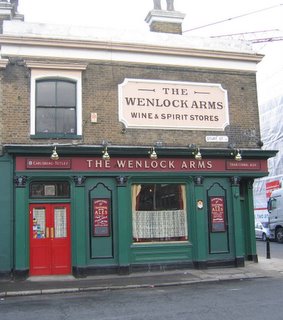
I used to visit the Wenlock Arms occasionally in my younger days, when I lived in that part of the world. It went into a bit of a decline, and it has been almost two decades since I was last there. I was delighted to renew my acquaintance. It seems to have changed very little in appearance over the years, but the beer is much better than I remember, both in range and quality. I am not at all surprised that it tends to win CAMRA awards.
The Wenlock name comes from the mediaeval moated manor house of Wenlock's Barn that once stood nearby. In addition to the pub, the name has attached to a couple of local streets, and to the Wenlock Basin, which branches off the Regent's Canal.
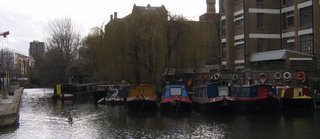 It is shown on Greenwood's 1827 Map of London - it is the unnamed basin in the top right-hand corner, which looks like a very new addition to the map, as the lines symbolising water don't follow the edge of the basin. Wenlock's Barn is shown at the top left-hand corner of the next panel of the map. It would appear that the pub postdates the Regency by a few years, as they make clear.
 If you ever visit, then the sandwiches are well worth sampling. Proper doorsteps, made with extremely fresh bread. Salt Beef seems to be the favourite variety, but I went for black pudding.
There are building works on the other side of the street, with luxury apartments going up with views of the pub or the basin. One would make the ideal Wenlock London pied-à-terre.

I used to visit the Wenlock Arms occasionally in my younger days, when I lived in that part of the world. It went into a bit of a decline, and it has been almost two decades since I was last there. I was delighted to renew my acquaintance. It seems to have changed very little in appearance over the years, but the beer is much better than I remember, both in range and quality. I am not at all surprised that it tends to win CAMRA awards.
The Wenlock name comes from the mediaeval moated manor house of Wenlock's Barn that once stood nearby. In addition to the pub, the name has attached to a couple of local streets, and to the Wenlock Basin, which branches off the Regent's Canal.
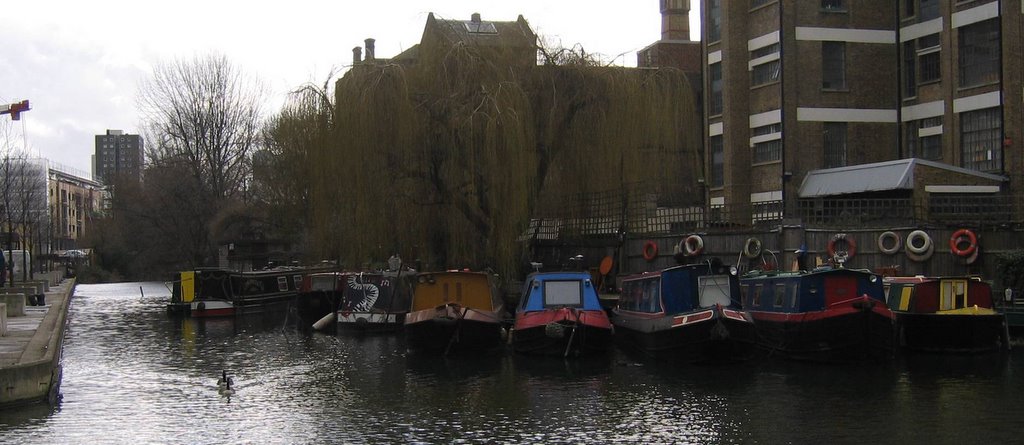 It is shown on Greenwood's 1827 Map of London - it is the unnamed basin in the top right-hand corner, which looks like a very new addition to the map, as the lines symbolising water don't follow the edge of the basin. Wenlock's Barn is shown at the top left-hand corner of the next panel of the map. It would appear that the pub postdates the Regency by a few years, as they make clear.
 If you ever visit, then the sandwiches are well worth sampling. Proper doorsteps, made with extremely fresh bread. Salt Beef seems to be the favourite variety, but I went for black pudding.
There are building works on the other side of the street, with luxury apartments going up with views of the pub or the basin. One would make the ideal Wenlock London pied-à-terre.
Friday, 17 February 2006
The Wenlock family is just back from a visit to the Great Wen, to borrow Mr Cobbett's charming phrase (but then you should see what he has to say about the delightful spa town in which Wenlock currently has his abode). One of the principal purposes of the visit was to take part in a Valentine's Day debate at Upminster Library on the motion that men are as romantic as women.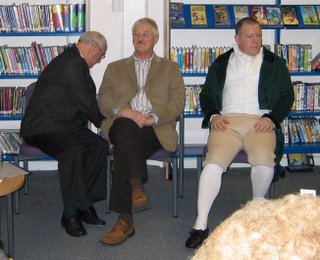
Proposing the motion were, from left to right, Roger Sanderson (caught in the act of producing some red roses for our opponents), Michael Taylor and Wenlock. Despite (or perhaps because of) meeting in a nearby hostelry some ninety minutes beforehand in order to work out some tactics, I am not sure quite how coherent our line of attack was, although Julie Cohen makes a brave attempt to explain it.
My own argument was from the heroes of classic romantic novels: Heathcliffe, Max de Winter, Rhett Butler, Rochester and, of course, Darcy. They may not always be pleasant to have around, being frequently selfish, arrogant, rude and grim (and not always having Ten Thousand a year to make up for it), but despite these failings they are somewhat more stirring of the emotions than the assorted Janes, Lizzies and Cathys against whom they play out their parts. I would be tempted to exempt Scarlet O'Hara from such criticism were she not such a self-centered cow who really ought to have come in for more of a slapping than Bridget Jones. As for the second Mrs De Winter: as a heroine I reckon that she shows less personality than either her predecessor (who labours under the disadvantage of being more than somewhat dead), or indeed Manderley.
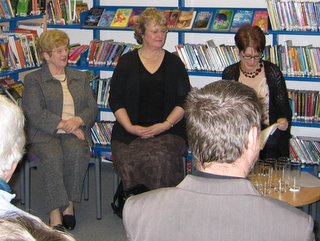 Our opponents were, from right to left, Julie Cohen, Katie Fforde and Elizabeth Lord. Julie's arguments tended to involve reading out smutty lyrics from current hit records, and noting that her husband had nobly sent her off to Upminster on Valentine's Night rather than staying in for champagne and chocolate (Mrs Wenlock chose to accompany to the debate, and it was she who took these photographs, but I would not want to use that fact to score any debating points. Katie brought the subject of cheesecutter thongs into the debate, while Elizabeth Lord accused Byron of writing for money (I am giving a somewhat partial account of things, in both senses of the word - Julie's account is probably more reliable).
After the audience had had their say there was a poll of the audience, which ended in a tie broken by the chairman's casting vote which went to our side. We then went back to the pub. All in all, a very enjoyable way to spend the evening of Valentine's Day.

Proposing the motion were, from left to right, Roger Sanderson (caught in the act of producing some red roses for our opponents), Michael Taylor and Wenlock. Despite (or perhaps because of) meeting in a nearby hostelry some ninety minutes beforehand in order to work out some tactics, I am not sure quite how coherent our line of attack was, although Julie Cohen makes a brave attempt to explain it.
My own argument was from the heroes of classic romantic novels: Heathcliffe, Max de Winter, Rhett Butler, Rochester and, of course, Darcy. They may not always be pleasant to have around, being frequently selfish, arrogant, rude and grim (and not always having Ten Thousand a year to make up for it), but despite these failings they are somewhat more stirring of the emotions than the assorted Janes, Lizzies and Cathys against whom they play out their parts. I would be tempted to exempt Scarlet O'Hara from such criticism were she not such a self-centered cow who really ought to have come in for more of a slapping than Bridget Jones. As for the second Mrs De Winter: as a heroine I reckon that she shows less personality than either her predecessor (who labours under the disadvantage of being more than somewhat dead), or indeed Manderley.
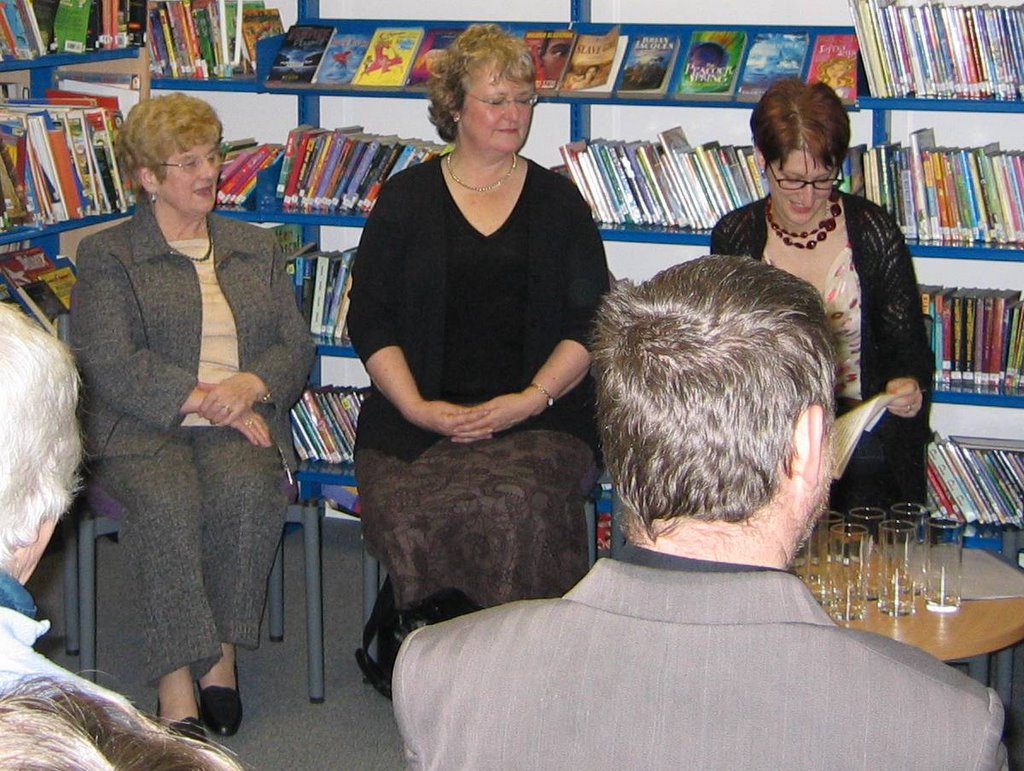 Our opponents were, from right to left, Julie Cohen, Katie Fforde and Elizabeth Lord. Julie's arguments tended to involve reading out smutty lyrics from current hit records, and noting that her husband had nobly sent her off to Upminster on Valentine's Night rather than staying in for champagne and chocolate (Mrs Wenlock chose to accompany to the debate, and it was she who took these photographs, but I would not want to use that fact to score any debating points. Katie brought the subject of cheesecutter thongs into the debate, while Elizabeth Lord accused Byron of writing for money (I am giving a somewhat partial account of things, in both senses of the word - Julie's account is probably more reliable).
After the audience had had their say there was a poll of the audience, which ended in a tie broken by the chairman's casting vote which went to our side. We then went back to the pub. All in all, a very enjoyable way to spend the evening of Valentine's Day.
Sunday, 12 February 2006
Heyeroines in need of a slap
18. Henrietta Silverdale (Charity Girl)
 It is hardly an unusual position to be in. We saw it five years earlier with Sir Gareth Ludlow, and we shall see it again in a year or so with his Grace Adolphus Gillespie Vernon Ware. A heyero arrives with some unsuitably young girl in tow, drops her off with you and your family to look after, and then goes gallivanting off on his adventures. What can you do?
Well, if you are Miss Silverdale you can do a great deal better than meekly accepting the situation and leaving your reader to endure Ashley Carrington on the Road, a deeply unedifying travelogue involving High Harrowgate, Low Harrowgate and all that lies between (more than would be strictly necessary if only Carrington, or, as we should perhaps more properly style him, Viscount 'Des' Desford, could be bothered to go via the stile), and which takes in unduly frosty landladies and unduly cantankerous old men who have married their unduly plebeian housekeepers, or, as they apparently wish to be styled (as if it made a ha'porth of difference), 'Lady Housekeepers'.
It is not as if Miss Silverdale's circumstances are exactly unpropitious. A household containing an unmarried daughter and an ineffectual father (ineffectual as a result of having died some years earlier, but that is beside the point) discovers that a nearby house has been occupied by a single man in possession of a fortune. If the house is not called 'Nether-something' then at least the single gentleman is. This is surely something that a heyeroine with a ready intelligence and a good sense of humour could make something of - perhaps the new neighbour, who after all is bound to fall in love with somebody in the household, might have a good friend who is rich and handsome, but lacking in manners?
Or if not that, then what about the female servant whose loyalty to the woman she still considers as her mistress is threatened by a new arrival, an apparent interloper who has been swept off her feet and delivered to the house without anyone really having thought things through, and who, as a result, ends up in very real danger of her life. Could Miss Silverdale really not come up with the idea that somebody might, one night, have dreamed they went to Inglehurst?
But no. Miss Silverdale appears to believe that she should take as a role model Lady Hester Theale, and do the dutiful wet-goose thing. Such behaviour in one described by no less an authority than Simon Carrington as "sound as a trout" simply will not do. What if Fitzwilliam Darcy had decided that, rather than hanging out with Bingley and generally making things happen, he would prefer to be as dull an old stick as Henry Tilney? What if John Melmoth had stayed at home? What if Montoni had brought in an architect to remodel Udolpho along Palladian lines?
It is simply not to be thought of, and yet in Miss Henrietta Silverdale we have a heyeroine so lacking in romantic sensibility that instead of a cat fight between Miss Charity Steane and the frightfulMrs Danvers Hepzibah Cardle we have Wilfred Steane in a purple jacket being tedious with Simon Carrington; instead of wild happenings in the stormy woods around Otranto Inglehurst we have Desford's groom getting into a snit. This is not Byronic, this is not Gothic, this is not remotely horrid.
If this is what we must expect from our heyeroines, we might as well go back to the Brontës.
Technorati Tags: heyeroines
18. Henrietta Silverdale (Charity Girl)
It is hardly an unusual position to be in. We saw it five years earlier with Sir Gareth Ludlow, and we shall see it again in a year or so with his Grace Adolphus Gillespie Vernon Ware. A heyero arrives with some unsuitably young girl in tow, drops her off with you and your family to look after, and then goes gallivanting off on his adventures. What can you do?Well, if you are Miss Silverdale you can do a great deal better than meekly accepting the situation and leaving your reader to endure Ashley Carrington on the Road, a deeply unedifying travelogue involving High Harrowgate, Low Harrowgate and all that lies between (more than would be strictly necessary if only Carrington, or, as we should perhaps more properly style him, Viscount 'Des' Desford, could be bothered to go via the stile), and which takes in unduly frosty landladies and unduly cantankerous old men who have married their unduly plebeian housekeepers, or, as they apparently wish to be styled (as if it made a ha'porth of difference), 'Lady Housekeepers'.
It is not as if Miss Silverdale's circumstances are exactly unpropitious. A household containing an unmarried daughter and an ineffectual father (ineffectual as a result of having died some years earlier, but that is beside the point) discovers that a nearby house has been occupied by a single man in possession of a fortune. If the house is not called 'Nether-something' then at least the single gentleman is. This is surely something that a heyeroine with a ready intelligence and a good sense of humour could make something of - perhaps the new neighbour, who after all is bound to fall in love with somebody in the household, might have a good friend who is rich and handsome, but lacking in manners?
Or if not that, then what about the female servant whose loyalty to the woman she still considers as her mistress is threatened by a new arrival, an apparent interloper who has been swept off her feet and delivered to the house without anyone really having thought things through, and who, as a result, ends up in very real danger of her life. Could Miss Silverdale really not come up with the idea that somebody might, one night, have dreamed they went to Inglehurst?
But no. Miss Silverdale appears to believe that she should take as a role model Lady Hester Theale, and do the dutiful wet-goose thing. Such behaviour in one described by no less an authority than Simon Carrington as "sound as a trout" simply will not do. What if Fitzwilliam Darcy had decided that, rather than hanging out with Bingley and generally making things happen, he would prefer to be as dull an old stick as Henry Tilney? What if John Melmoth had stayed at home? What if Montoni had brought in an architect to remodel Udolpho along Palladian lines?
It is simply not to be thought of, and yet in Miss Henrietta Silverdale we have a heyeroine so lacking in romantic sensibility that instead of a cat fight between Miss Charity Steane and the frightful
If this is what we must expect from our heyeroines, we might as well go back to the Brontës.
Technorati Tags: heyeroines
Sunday, 5 February 2006
There has been a fair amount of discussion of viewpoint in the last few days on ROMNA, the mailing list (or, as it calls itself, the cyber chapter) of the Romantic Novelists' Association. Hilary Johnson, who runs a highly respected Authors' Advisory Service, has said that viewpoint is the single biggest source of problems in the typescripts that she is sent.
I know that some writers have trouble with viewpoint, but until today I had thought that I found it easy enough to understand, and to handle. It is, after all, simply a matter of deciding through whose eyes you are seeing the action, and only writing about what that character sees, feels or knows.
The important part is sticking to the same viewpoint through a whole scene. In some cases, of course, it is a matter of sticking to the same viewpoint for the whole book. With the fairly convoluted plot of Lord Alexander's Cipher; or, the Bridekirk Behemoth I knew that I would not be able to manage this.
So, what has been my problem today?
I was rewriting a scene early in the book, and I wanted to use it to cast a bit more light on Lord Alexander, without going in for too much internal reflection - I need to keep the pace up at this point in the story. I therefore chose to use the other character in the scene as the viewpoint character. This made it easier to describe our hero, in terms of his dress, his manner, the colour of his eyes. However it became much harder to drive the action forward.
My viewpoint character's role in the scene was rather reactive. He knows things that Lord Alexander needs to learn, but he doesn't do anything to drive the story along. This turned out to be a problem, because I couldn't use his knowledge directly. It was no good his thinking about what he knows; he still had to tell Lord Alexander, and the repetition was killing the pace. If he didn't think about it, then the whole scene became a load of telling, not showing, and that made for dead prose too.
In the end I had to scrap the whole rewrite, after about 2,000 words, and start again, with Lord Alexander as the viewpoint character. Once I made that rather painful decision everything started flowing much more easily, and I am sure that the result will be much tauter.
I just can't afford to make this sort of mistake too often, because I have at least a soft deadline ahead of me.
I know that some writers have trouble with viewpoint, but until today I had thought that I found it easy enough to understand, and to handle. It is, after all, simply a matter of deciding through whose eyes you are seeing the action, and only writing about what that character sees, feels or knows.
The important part is sticking to the same viewpoint through a whole scene. In some cases, of course, it is a matter of sticking to the same viewpoint for the whole book. With the fairly convoluted plot of Lord Alexander's Cipher; or, the Bridekirk Behemoth I knew that I would not be able to manage this.
So, what has been my problem today?
I was rewriting a scene early in the book, and I wanted to use it to cast a bit more light on Lord Alexander, without going in for too much internal reflection - I need to keep the pace up at this point in the story. I therefore chose to use the other character in the scene as the viewpoint character. This made it easier to describe our hero, in terms of his dress, his manner, the colour of his eyes. However it became much harder to drive the action forward.
My viewpoint character's role in the scene was rather reactive. He knows things that Lord Alexander needs to learn, but he doesn't do anything to drive the story along. This turned out to be a problem, because I couldn't use his knowledge directly. It was no good his thinking about what he knows; he still had to tell Lord Alexander, and the repetition was killing the pace. If he didn't think about it, then the whole scene became a load of telling, not showing, and that made for dead prose too.
In the end I had to scrap the whole rewrite, after about 2,000 words, and start again, with Lord Alexander as the viewpoint character. Once I made that rather painful decision everything started flowing much more easily, and I am sure that the result will be much tauter.
I just can't afford to make this sort of mistake too often, because I have at least a soft deadline ahead of me.
Saturday, 4 February 2006
Some six months ago, in my very first post on Wenlock I said:
James Bond was, of course, the creation of Ian Fleming. Ian Fleming's literary agent was a man called Peter Janson-Smith. In 2003 he joined up with Peter Buckman to form the Ampersand Agency. The most notable name on their client list is (the estate of) Georgette Heyer.
At some point soon another name will be going up on that client list - mine. Having started by claiming literary kinship with two of the most popular authors of the last 50 years, I now find myself represented by an agency with strong connections to both.
Which is nice.
I am currently working on a Romantic Regency Romp, James Bond meets Georgette Heyer, complete with fireworks and at least one elephant.Rather a presumptious statement, now I look back on it.
James Bond was, of course, the creation of Ian Fleming. Ian Fleming's literary agent was a man called Peter Janson-Smith. In 2003 he joined up with Peter Buckman to form the Ampersand Agency. The most notable name on their client list is (the estate of) Georgette Heyer.
At some point soon another name will be going up on that client list - mine. Having started by claiming literary kinship with two of the most popular authors of the last 50 years, I now find myself represented by an agency with strong connections to both.
Which is nice.
Thursday, 2 February 2006
There is a much misquoted remark by Anton Chekhov that originally read something like
The rewriting that I am doing at the moment is in part a matter of removing undischarged rifles from the stage. Having done no plotting at all when I started to write, I put quite a number of contrivances and devices into the early chapters because I thought that they might come in handy later on. I was actually surprised how many of them did turn out to be useful - including a walk-on Frenchman and, most importantly, a scene-stealing elephant. But not all of them were winners.
My problem is that the rifles are not always that easy to remove. Some of them are like the Dude's rug in The Big Lebowski. That rug really tied the room together. Take it away, and there is a big empty space.
There is one particular rifle that I am working on at the moment. In fact it is a Japanese miniature tinder pistol. I saw this picture of it and decided that it would be a perfect gadget for Lord Alexander to carry with him and use in an emergency, just as James Bond is equipped with various miniature gadgets usually disguised as fountain pens or watches.
The tinder pistol formed the basis of a conversation in Chapter One between Lord Alexander and his friend Sir Peregrine Caradoc (a slightly eccentric Natural Philosopher) during which they revealed some of the backstory. The problem was that at no subsequent point in the plot did a situation arise in which Lord Alexander needed to start a fire. So I find that I must confiscate the tinder pistol and give him something else to discuss with Sir Peregrine.
Luckily I also need to put a few rifles onto the stage too: rifles that are fired, but fired a little implausibly because we hadn't already been alerted to their existence. In this particular case I have found myself removing a miniature-tinder-pistol-shaped rifle, and replacing it with a very-large-gas-balloon-shaped one. Not surprisingly, this has required me to completely rebuild the stage.
It is at times like this that I think how lucky I am that my agent could see enough good stuff in Lord Alexander's Cipher; or, the Bridekirk Behemoth that she was not put off by such flaws.
One must not put a loaded rifle on the stage if no one is thinking of firing it.(although on the web it is usually described as putting pistols on mantelpieces.)
(From a letter to Aleksandr Semenovich Lazarev, 1 November 1889)
The rewriting that I am doing at the moment is in part a matter of removing undischarged rifles from the stage. Having done no plotting at all when I started to write, I put quite a number of contrivances and devices into the early chapters because I thought that they might come in handy later on. I was actually surprised how many of them did turn out to be useful - including a walk-on Frenchman and, most importantly, a scene-stealing elephant. But not all of them were winners.
My problem is that the rifles are not always that easy to remove. Some of them are like the Dude's rug in The Big Lebowski. That rug really tied the room together. Take it away, and there is a big empty space.
There is one particular rifle that I am working on at the moment. In fact it is a Japanese miniature tinder pistol. I saw this picture of it and decided that it would be a perfect gadget for Lord Alexander to carry with him and use in an emergency, just as James Bond is equipped with various miniature gadgets usually disguised as fountain pens or watches.
The tinder pistol formed the basis of a conversation in Chapter One between Lord Alexander and his friend Sir Peregrine Caradoc (a slightly eccentric Natural Philosopher) during which they revealed some of the backstory. The problem was that at no subsequent point in the plot did a situation arise in which Lord Alexander needed to start a fire. So I find that I must confiscate the tinder pistol and give him something else to discuss with Sir Peregrine.
Luckily I also need to put a few rifles onto the stage too: rifles that are fired, but fired a little implausibly because we hadn't already been alerted to their existence. In this particular case I have found myself removing a miniature-tinder-pistol-shaped rifle, and replacing it with a very-large-gas-balloon-shaped one. Not surprisingly, this has required me to completely rebuild the stage.
It is at times like this that I think how lucky I am that my agent could see enough good stuff in Lord Alexander's Cipher; or, the Bridekirk Behemoth that she was not put off by such flaws.
Subscribe to:
Posts (Atom)